
How to avoid quoting the wrong product
Two products can look the same. That doesn't mean they do the same job.
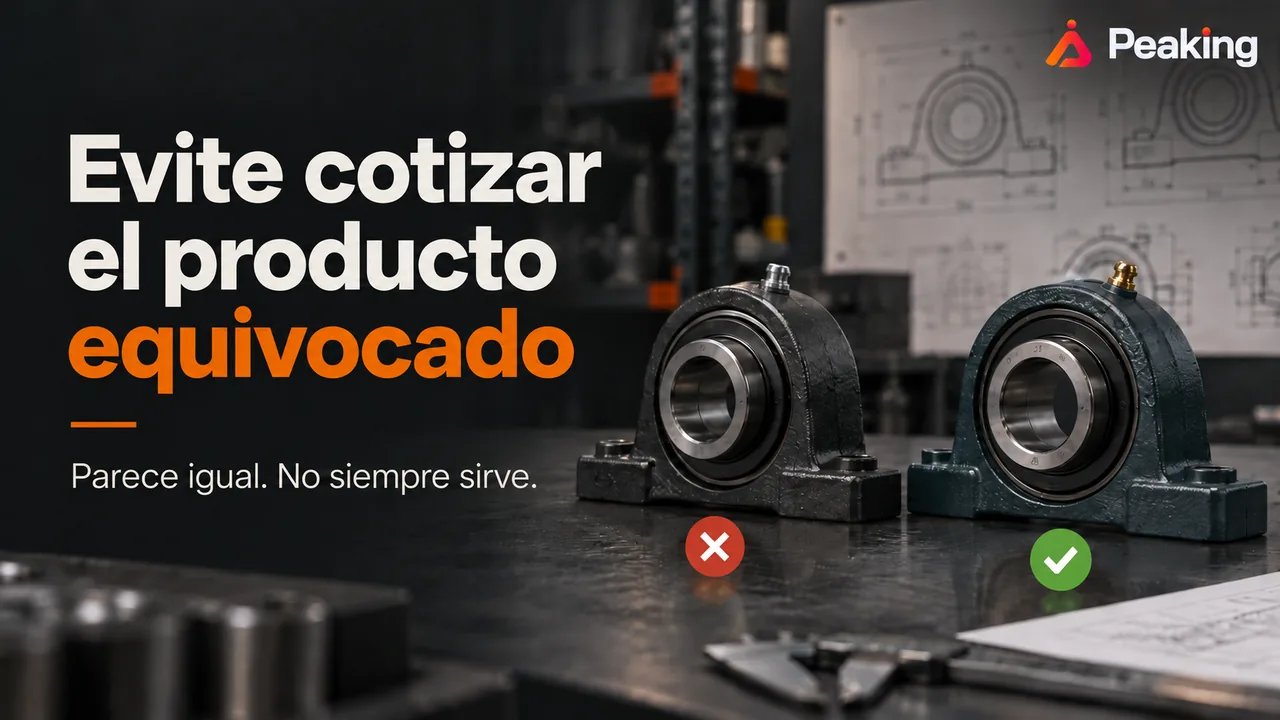
To avoid quoting the wrong product, confirm the application, identify the specifications that can't change, verify equivalents before offering them, clarify what's missing before sending, and check that what you quoted matches what was requested.
In industrial distribution, receiving a quote request doesn't always mean having everything you need to answer it. One customer sends a photo. Another shares an incomplete part number. Someone in maintenance needs to replace a failed part and asks for an urgent alternative.
The rep knows the business. But across brands, specifications, applications and thousands of references, finding the right product can take more information than the request contains. That's the risk: quoting something that looks right but doesn't meet what the application needs.
Why do the wrong products get quoted?
The problem doesn't always begin in the catalog. It often begins earlier, with the information that's missing.
Imagine a customer asks for a belt for their conveyor. They give the width and length but don't mention operating temperature, the material being conveyed or the working conditions. Several options may appear, some with identical dimensions, and they aren't necessarily designed for the same conditions.
Finding a similar product isn't the same as finding the right product.
The same happens with bearings, seals, valves, fittings, motors and other industrial components. The challenge isn't a lack of knowledge on the sales team. Each product family has variables, exceptions and conditions that must be considered to make a safe decision.
5 steps to avoid errors when quoting industrial products
1. Confirm the application, not just the product name
Knowing what the customer is asking for matters. Knowing where and how they'll use it can be decisive. "I need a 2-inch valve" still leaves open questions: what fluid, what pressure, what temperature, what connection? The answers separate products that belong to the same category but aren't interchangeable.
2. Identify the specifications that can't change
Not every characteristic carries the same weight. Depending on the category, review dimensions and connection type, materials and chemical compatibility, pressure, temperature and working load, voltage and power, and required standards or certifications. If a specification determines compatibility or safety, it can't be assumed.
3. Verify equivalents before offering an alternative
Similar dimensions don't make two products equivalent. Before offering an alternative, compare the relevant characteristics, review the manufacturer's documentation and confirm the conditions under which it can be used. A valid alternative isn't the one that looks most alike. It's the one that still meets what the customer needs.
4. Clarify what's missing before sending the quote
A well-placed question can prevent a wrong quote. If a customer sends a photo of a damaged pressure gauge, you may recognize the instrument and its connection, but that doesn't confirm the required pressure range. The important thing is that the doubt is identified, not hidden inside a commercial proposal.
5. Check that what you quoted matches what was requested
Before sending, check that the description, model, quantity and specifications match the selected product. Also review availability, applicable price, delivery time and any condition the customer should know. If the request involves several components, confirm they're compatible with each other.
The real problem: information in too many places
At many distributors, the knowledge needed to quote is spread across manufacturer catalogs, spec sheets, sales history, internal files and the experience of different specialists. The team knows how to work with these sources. What takes time is pulling them together for every request.
Technical precision is essential. The friction to reach it isn't.
How does Peaking help quote the right product?
Peaking helps industrial distributors go from a request to a correct commercial response without rebuilding the information from scratch. A request can arrive as a message, photo, audio, part number or technical document, through the channels your team already uses, and Peaking helps relate it to the products in your catalog.
If an important detail is missing, Peaking can ask for clarification. If the uncertainty requires a specialist, the case can go to the team with the context already gathered. The goal is for the rep to reach the right answer with less searching and coordination, while keeping their commercial judgment.
See it appliedDistributor stories with figures read from their own systems.
Frequently asked questions
Why do distributors quote the wrong product?
Usually because information is missing from the request. A belt can match the requested dimensions and still be unsuitable for the operating temperature. Finding a similar product isn't the same as finding the right one.
How can you avoid quoting the wrong product?
Confirm the application, identify the specifications that can't change, verify equivalents before offering them, clarify what's missing before sending, and check that what you quoted matches what was requested.
Does speed have to come at the cost of accuracy?
No. A fast response can keep an opportunity alive, and a correct one lets it move forward. Distributors need processes that identify the right product and validate its requirements without unnecessary delays.
You've got this.
Book a demo and see what this article describes, on your own catalog.